No. 01
Practise when nothing is wrong
A breathing exercise tried for the first time mid-crisis is a coin flip. Tried nightly for a week beforehand, it's a groove your body already knows.
Topic guide · Calm tools
In the middle of a meltdown — yours or theirs — nobody has capacity for a wellness routine. What helps is having the thing you reach for already decided, already two taps away, already practised.
The reality
Everyone has been handed the same advice: breathe, ground yourself, stay calm. It's not wrong. It's just useless as a set of instructions to recall at the exact moment your nervous system has other plans.
What works is reducing the moment to one decision: open the toolkit. Everything past that — the breathing pattern, the grounding steps, the helpline numbers — is already laid out, because you chose it on a calmer day.
In practice
The tools are simple. The practice around them is what makes them hold in real family life.
No. 01
A breathing exercise tried for the first time mid-crisis is a coin flip. Tried nightly for a week beforehand, it's a groove your body already knows.
No. 02
Children co-regulate — they borrow a nearby adult's nervous system before they can steady their own. Using a tool yourself isn't stepping away from helping; it usually is the helping.
No. 03
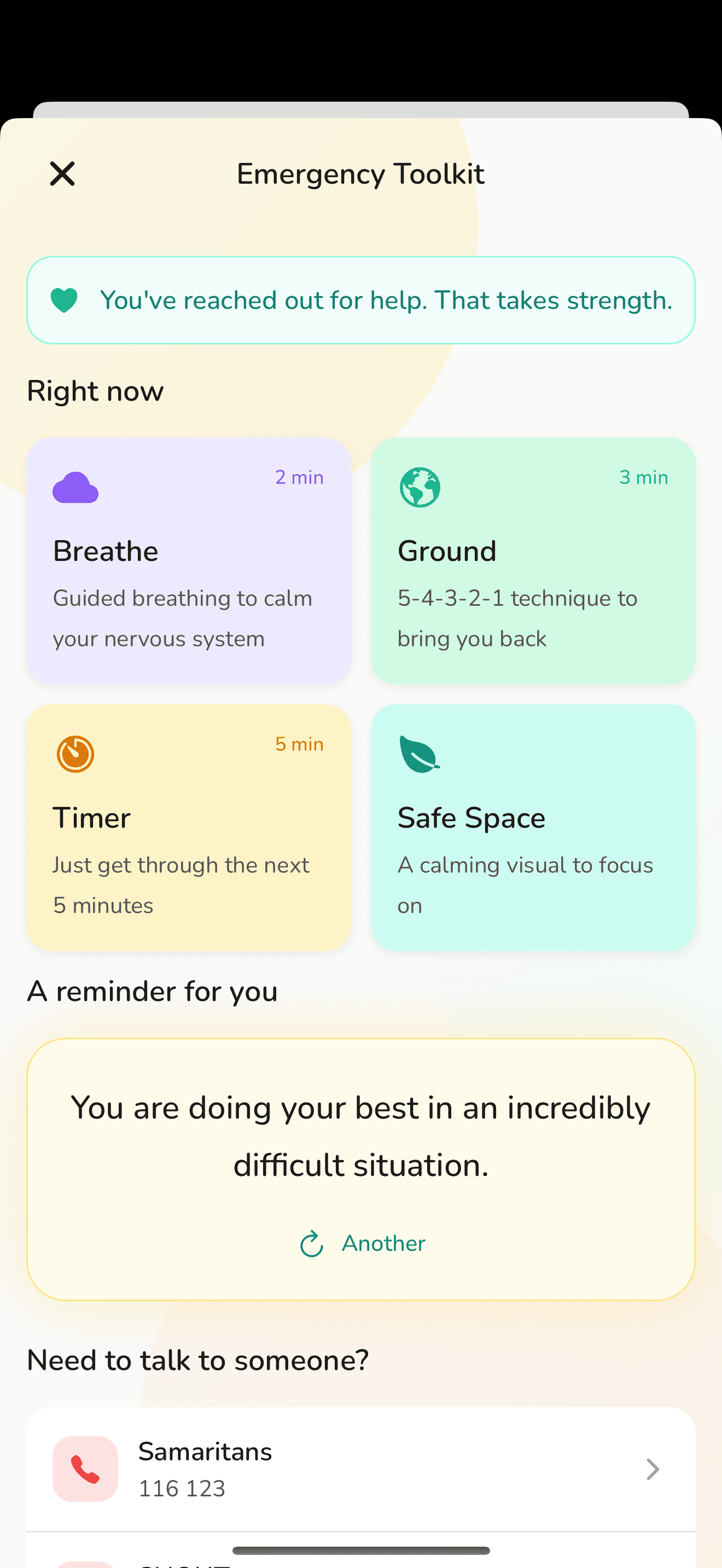
Pick your two or three tools in advance and put them where no searching is required. In Heedli the toolkit is two taps from anywhere, on purpose.
No. 04
When the storm passes, log one line: what happened, what you tried, whether it helped. Over months, that's how you learn which tools are yours.
No. 05
Calm tools are for hard moments, not emergencies. If anyone is at immediate risk of harm, that's 999; for urgent medical advice, NHS 111. Decide those thresholds on a calm day too.
Inside Heedli
Everything below is designed to be found fast, with shaking hands, at 3pm in a supermarket or 3am on a landing.
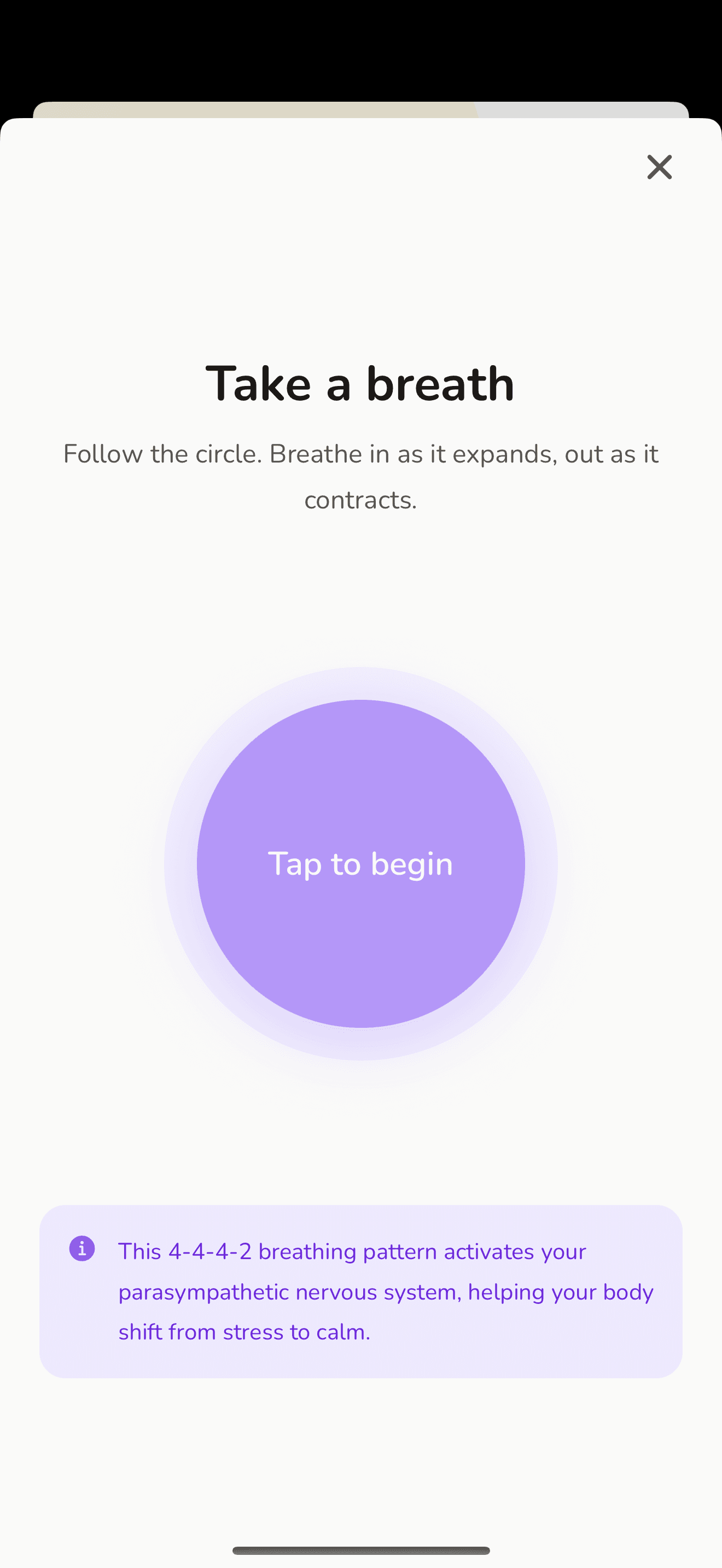
A 4-4-4-2 pattern — in, hold, out, rest — traced by an expanding circle you can follow without reading anything.
Step-by-step grounding prompts and a simple timer, for riding out the minutes that feel much longer than minutes.
A quiet screen with what helps your child — chosen in advance, by you and them.
The crisis lines that matter, kept inside the toolkit — because searching for a phone number is not a 3am job.
Common questions
Both. Parents and carers have the toolkit in their space, and young people have age-appropriate versions in the Young Person Hub — because hard moments don't check whose they are.
Breathe in for four counts, hold for four, out for four, rest for two — a steady rhythm that's easy to follow from a visual. The point isn't the exact numbers; it's giving your breath a pattern to land on.
No. These are self-help tools for hard moments. Heedli isn't monitored in real time and is not a crisis service — if anyone may be at immediate risk, contact 999, NHS 111, your GP or local crisis support.
Not as a score — as a quiet record. Reaching for help is a strategy worth noticing, and over time it shows you which tools actually work for your family.
Keep reading
Free to download on iOS and Android. Built for daily life, school meetings and hard moments.
Questions? We answer every email.